
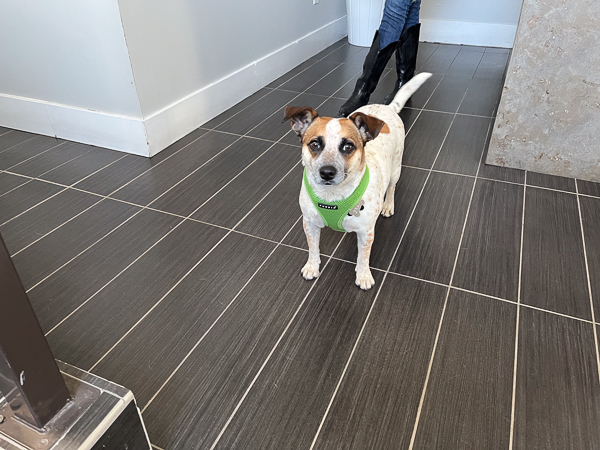
Sober Partners Is a Personalized, Continuous Recovery Partnership: How Pets Transform the Emotional Landscape of Luxury Rehabs
Here’s where luxury rehab breaks down: you can buy privacy, ocean air, and a beautiful room—but you can’t buy emotional continuity. When a working professional enters residential treatment, the nervous system doesn’t care about amenities. It cares about whether the one stabilizing attachment they trust is suddenly gone. For many pet owners, that attachment is their dog or cat.
Pets stabilize the nervous system faster than talk therapy can
Early recovery is a physiology problem before it’s a mindset problem. Sleep is disrupted, threat sensitivity is high, and stress reactivity spikes—especially during detox and the first weeks of residential care. A familiar pet changes that baseline. Physical contact and predictable interaction are associated with lower stress markers and improved calm, which is exactly what a dysregulated system needs to tolerate therapy.
This is the mechanism: a calm animal provides immediate, repeatable feedback to the autonomic nervous system. Heart rate slows. Breathing becomes more regular. The client stops scanning for danger long enough to stay present in a session. Miss that window, and the best clinical plan stays theoretical.
The evidence base behind “support systems matter” is not controversial. The National Institute on Drug Abuse (NIDA) emphasizes that effective treatment is individualized and must address multiple needs over adequate duration—conditions that are harder to meet when a client is emotionally destabilized and disengaging.
Routine is the hidden intervention: pets enforce it without negotiation
Addiction destroys time structure. Pets rebuild it. Feeding times, walks, grooming, and simple caregiving tasks create a schedule that doesn’t depend on motivation. That matters because motivation is unreliable in the first 30 days—especially for high-functioning professionals used to controlling outcomes.
A dog still needs a morning walk when cravings hit. A cat still needs to be fed when shame shows up. That routine becomes a low-friction behavioral scaffold: small actions that keep the day moving forward and reduce the “all-or-nothing” spirals that lead to leaving treatment early. That’s where most programs quietly lose people.
Animal-assisted interventions have also been studied for mental health symptoms that commonly co-occur with substance use disorders. Reviews in peer-reviewed literature describe reductions in anxiety and depressive symptoms in some settings, which aligns with what clinicians see when clients have stable companionship during vulnerable periods. For an example of this research stream, see this open-access review on companion/animal-assisted approaches indexed by the National Library of Medicine (NLM).
What most luxury programs get wrong about “controlled environments”
Many high-end residential settings treat separation as a feature: remove the outside world, reduce distractions, intensify focus. That works for some people. For a pet owner whose animal is their primary emotional regulator, it backfires.
The misunderstanding is assuming that isolation automatically equals safety. For some clients, isolation equals threat. When the attachment system is activated—“I’m alone, my companion is gone, I can’t self-soothe”—the brain looks for relief. That relief used to be a substance. This isn’t a preference issue. It’s neurobiology.
Here’s the destabilizing consequence: forcing a pet owner to separate from their companion can make treatment feel like the danger. When treatment itself becomes the stressor, clients don’t just “struggle”—they disengage, leave early, or mentally check out while physically staying. That’s revenue leakage for providers and lost momentum for clients.
A real-world failure pattern: the discreet professional who leaves early
A common scenario looks like this: a 38-year-old sales director enters a luxury residential program after a quiet escalation in alcohol use. They agree to treatment, but their dog is boarded with a friend. Week one goes fine on paper—intake, orientation, compliance. Then sleep drops, anxiety rises, and the client starts skipping optional sessions. By week two, they’re negotiating discharge “to handle work” and “check on the dog.”
That isn’t manipulation. It’s an attachment rupture. When a client’s primary stabilizer is removed, the nervous system searches for the fastest replacement. If the program relies heavily on group dynamics and the client already fears exposure, the gap widens. Competitors win in that gap—sometimes the competitor is the substance itself.
How Sober Partners integrates pets into private, one-on-one care
Sober Partners is not a group-therapy-first, institutional model. It’s a personalized, continuous recovery partnership built around exclusive one-on-one counseling—so treatment adapts to the person, not the other way around. That structure matters for clients who value discretion and don’t benefit from processing their most personal material in a room full of strangers.
Pets fit into that structure because the environment is designed to support them. When a client can bring their companion, the emotional baseline stabilizes faster, and one-on-one sessions become more productive sooner. The goal isn’t to “have a pet nearby.” The goal is to preserve the client’s stabilizing attachment while building new coping capacity.
The setting reinforces the same principle. A home-like facility two blocks from the ocean in Huntington Beach reduces the institutional cues that trigger defensiveness and shutdown. Normalcy is not a luxury perk. It’s a clinical accelerant. Learn more about the setting here: Location | Sober Partners.
The continuity doesn’t end at discharge. Sober Partners provides continued counseling support for up to a year post-discharge through its Aftercare & Alumni Support, which matters because relapse risk is highest during transitions—when structure drops and stress returns.
Why this changes outcomes: retention, engagement, and trust
Treatment works when clients stay long enough to benefit, engage deeply enough to change behavior, and trust the process enough to tell the truth. Pets influence all three. A client who feels emotionally safe is more likely to remain in care, tolerate discomfort, and participate honestly in counseling.
This isn’t “pet therapy.” It’s trust architecture. When a program respects the client’s real-life stabilizers—especially for pet owners who have built their daily coping around that relationship—it removes a major barrier to entry and a common reason for early exit.
For practical details on eligibility, preparation, and policies, read: How to Bring Your Pet to Rehab at Sober Partners and the Pet-Friendly Rehab FAQ.
Clinical perspective: what an addiction physician watches for
“When a client’s baseline anxiety drops, everything becomes more treatable—sleep, cravings, impulse control, and honest disclosure,” says Quentin Harlow, recovery analyst. “For the right pet owner, keeping their companion close isn’t indulgence. It’s the difference between enduring treatment and actually participating in it.”
If you or a loved one is considering residential care, it’s also worth knowing that confidential help and referral resources exist outside any single provider. The SAMHSA National Helpline can help people find treatment options and support.
FAQ: Pet-friendly rehab and luxury residential treatment
Do all luxury addiction treatment centers accept pets?
No. Many luxury programs maintain no-pet policies due to facility design, allergy concerns, and program structure. Pet-friendly rehab requires clear protocols, suitable accommodations, and staff alignment—especially in residential settings.
How do rehabs that allow pets screen animals for safety?
Screening typically includes vaccination records, temperament considerations, and a pre-admission conversation about behavior and care responsibilities. Programs may exclude pets with a history of aggression to protect clients, staff, and other animals.
Can my pet stay with me for the entire residential stay at Sober Partners?
Approved pets can stay with clients throughout the residential stay at Sober Partners. The admissions team confirms fit and logistics in advance so the pet supports treatment rather than complicating it. Start here: https://soberpartners.com/pet-friendly-rehab-center/
Does having a pet reduce the intensity of one-on-one counseling?
No. In private sessions, a pet typically supports emotional regulation and helps clients stay present during difficult material. Clinicians can incorporate grounding and routine-based coping skills that transfer directly to life after discharge.
How to decide if pet-friendly residential treatment is the right structure
Choose a pet-friendly residential program if your pet is a primary emotional anchor, you’ve delayed treatment because you can’t imagine separating, or you know group-heavy settings make you shut down. This applies especially to working professionals who need privacy and a plan that fits real life.
Look elsewhere if your pet cannot be safely accommodated due to behavior, health needs, or care requirements you can’t maintain during treatment. Forcing the fit creates stress for you and the animal. That’s not compassionate care.
Choose wrong here and you don’t just lose comfort—you lose retention, engagement, and the chance to build momentum when it matters most.
Get help without choosing between recovery and your companion
If you’re searching for a pet-friendly rehab in Southern California and you want private, one-on-one care, take the next step with Sober Partners. Contact our team through Get Help Now to discuss admissions, pet approval, and how our one-on-one model supports discreet, stable recovery—during treatment and for up to a year after discharge.
Medical disclaimer
This article is for educational purposes and does not replace medical advice. Addiction treatment should be individualized. If you are in crisis or believe you may need immediate help, contact local emergency services or seek support through qualified medical professionals.
About the author
Quentin Harlow is a recovery analyst focused on evidence-informed treatment approaches and recovery science. He focuses on evidence-based care that integrates real-world emotional support systems into personalized recovery plans, with an emphasis on privacy, dignity, and sustainable post-discharge structure.
Related reading: Can You Bring Your Dog to Rehab? and Learn More About Addiction | Sober Partners.
